
Greek grammar exercises with explanations
Vocabulum is a Telegram app with Greek grammar exercises: 2,800+ tasks on cases, articles, pronouns, verb tenses and moods. After every mistake you see why the answer is wrong, with a table of forms.
Grammar exercise examples
One session mixes different tasks: choose an ending, match forms, build a sentence, find a mistake, change the form of a word. After a mistake you get an explanation and a table of forms.
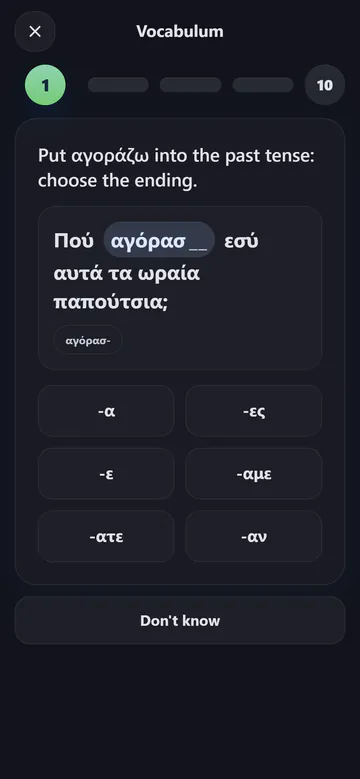
Choose the ending that puts the verb in the right form. The stem is already given. 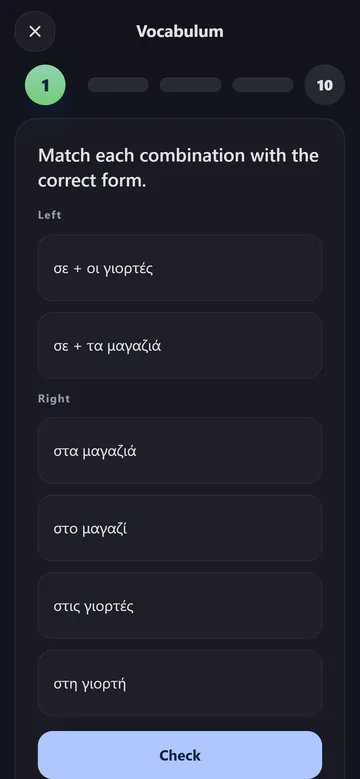
Match the pairs: for example, one word in different cases, or a preposition with the right form. 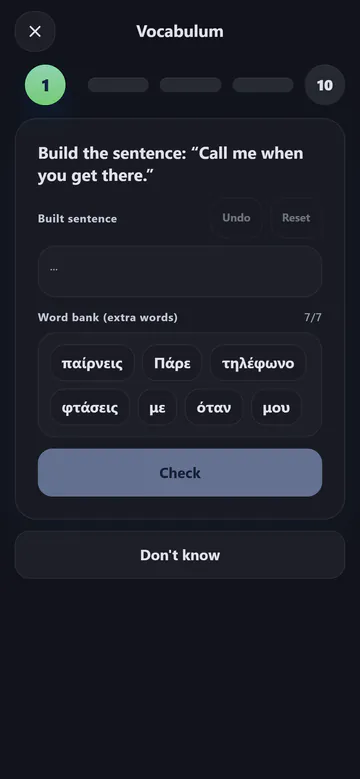
Build the sentence from its translation. The set includes extra words, such as similar verb forms. 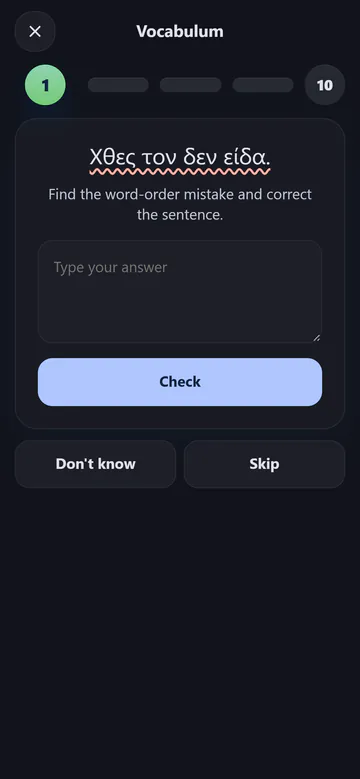
Find the mistake in the sentence and type it correctly. 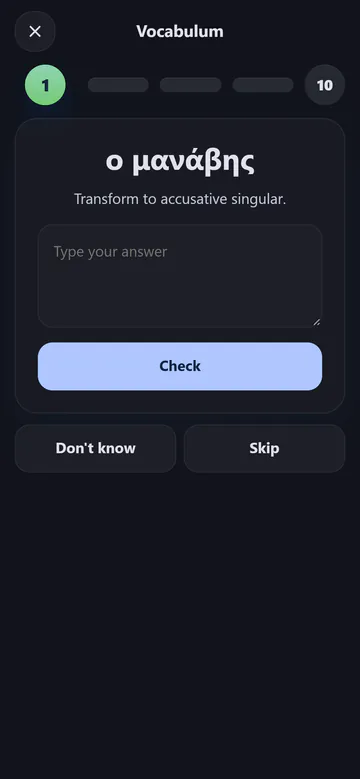
Put the word into the required form: another case, number, person or tense. You type the answer. 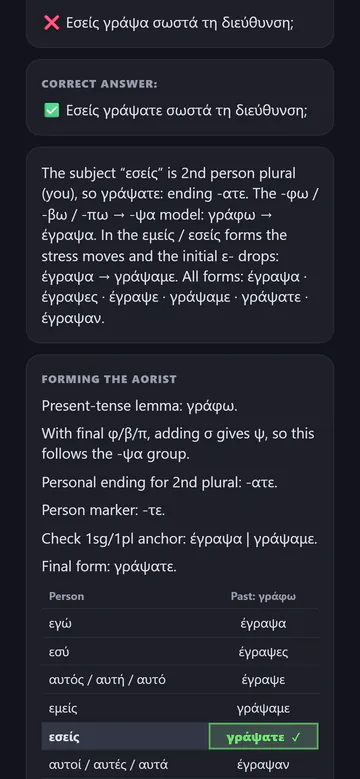
After a mistake, read the explanation and compare the forms in the table. Use this feedback to choose the ending in your next exercise.


How to open grammar in the app
The grammar trainer is on the Skills tab in the bottom menu. The grammar rules are there too, under Reference.
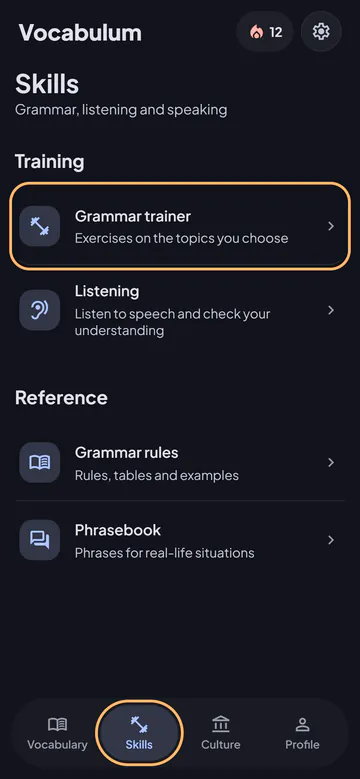
At the bottom of the screen, open the Skills tab and choose Grammar trainer. 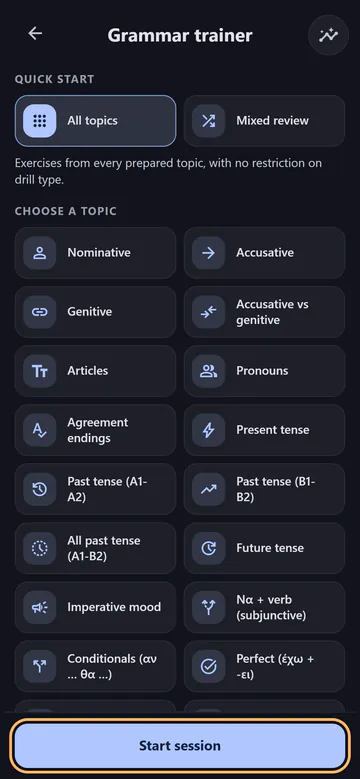
Choose a topic or keep All topics, then tap Start session.


18 grammar topics
We keep working on the grammar trainer: adding exercises and topics, expanding the examples and improving explanations of mistakes.
Choose one topic or combine selected topics and exercise types in a mixed review. For the present tense, you can focus on a conjugation type: Α, Β1, Β2, contracted verbs, Γ1 (-ομαι) or the verb είμαι. The topics below use the descriptions from the app:
- Nominative Focus on the subject, predicate nouns with είμαι, and nominative articles.
- Accusative Target direct-object forms and accusative usage.
- Genitive Focus on possession, relation, and genitive forms.
- Vocative Addressing people: names, common endings, and no article.
- Accusative vs genitive Resolve confusion between competing case forms.
- Articles Practice article changes without extra noise.
- Pronouns Work through possessive and object pronoun forms.
- Agreement endings Choose adjective and participle-like endings that match gender, number, and case.
- Present tense Translate from and into Greek: the verb ending alone marks person and number, with no pronouns.
- Past tense (A1-A2) 20 core verbs: aorist patterns and personal endings.
- Past tense (B1-B2) 21 B1-B2 verbs: the -ησα / -ασα / -εσα patterns and personal endings.
- Future tense Train future forms, present-to-future patterns, and common exceptions.
- Perfect (έχω + -ει) A result that holds now: έχω γράψει against έγραψα.
- Imperative mood Practice commands, prohibitions, forms for εσύ and εσείς, and clitic order.
- Να + verb (subjunctive) Practice να-constructions: verb forms and clitic pronouns.
- Mediopassive (-ομαι / -άμαι) Verbs like κοιμάμαι, ντύνομαι, έρχομαι and their endings.
- Conditionals (αν … θα …) A real condition in the future: αν + future form without θα, θα + future.
- Word order Tap tokens into the correct sentence order.
Types of grammar exercises
- choose the right ending;
- change a form: person, number, case or tense;
- fill a gap in a sentence;
- translate a sentence;
- match forms in pairs;
- put words in the right order;
- build a sentence yourself;
- find and fix a mistake.
Mistakes explained, with tables of forms
After an incorrect answer, the app explains the mistake. The table marks your answer and the correct form, so you can compare endings and see how the form changes by person, number or case.
Grammar rules reference
The grammar reference contains short rules with tables, examples and exceptions. If a rule has a word you don't know, there is no need to look for it elsewhere: the translate button opens a dictionary search right over the chapter. The app also tracks how well you know the forms covered by each rule.
Grammar goes well with everyday Greek phrases: the phrasebook shows the forms at work in sentences you can use right away.
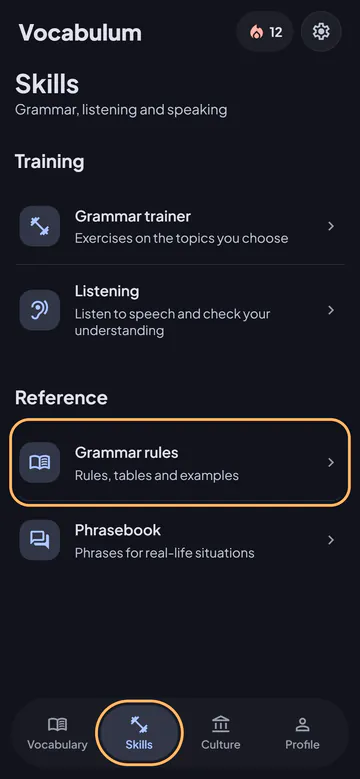
The rules are on the Skills tab: under Reference, choose Grammar rules. 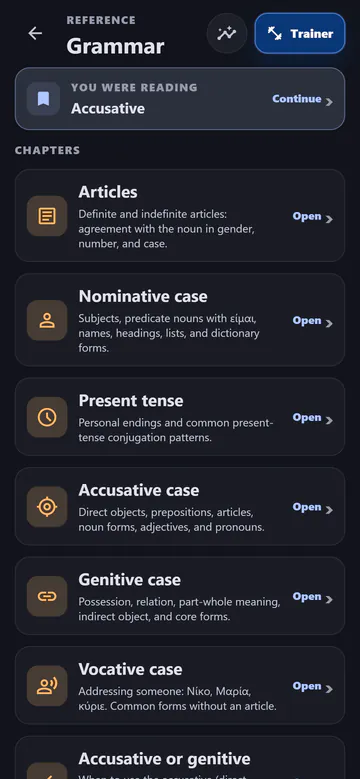
Each chapter covers one topic: a case, the articles, pronouns or a verb tense. The app remembers where you stopped and offers to pick up from there. 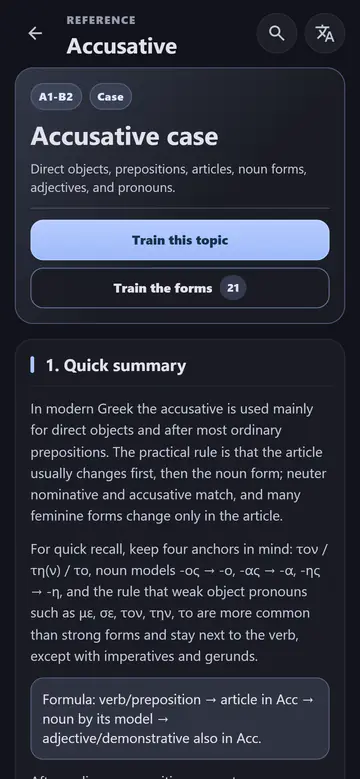
A chapter has tables with examples. The buttons above them start practice right away: the whole topic or just its forms. 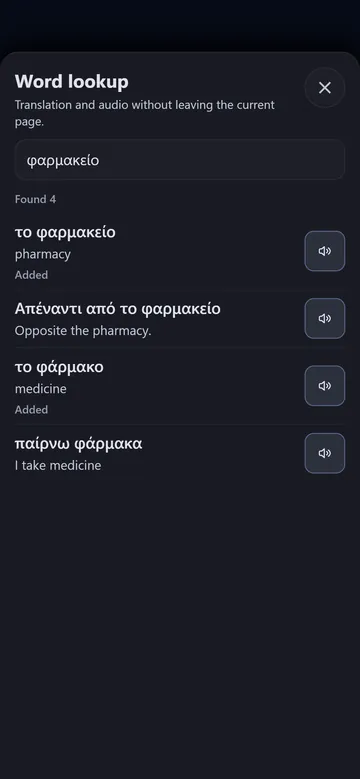
Look up an unfamiliar word without leaving the rule: the translate button at the top of a chapter opens a dictionary search.


Questions about grammar
Which grammar topics does Vocabulum cover?
Cases and articles, pronouns, adjective endings, the present, past and future tenses, the perfect, the imperative, να + verb, mediopassive verbs, conditionals and word order: 18 topics in total.
Are the rules and explanations in English?
Yes. Rules, explanations and instructions are written in English and in Russian and follow the interface language.
What level is the grammar for?
Topics range from A1 basics, such as articles and the present tense, to B1–B2 material. You can choose an individual topic and practice at your own pace.
See also
Everyday Greek phrases and A2 exam practice
Greek phrases for 12 situations and A2 speaking and writing tasks, with Russian translations in the cards. Phrase drills also support English.
Learn Greek vocabulary with spaced repetition
Greek dictionary with 7,200+ entries, audio and examples. A1–B1 collections for daily life and exam prep, 11 exercise types and spaced repetition.
Practice Greek grammar in Telegram
Open Vocabulum, choose Grammar trainer on the Skills tab and pick a topic: every mistake comes with an explanation.